


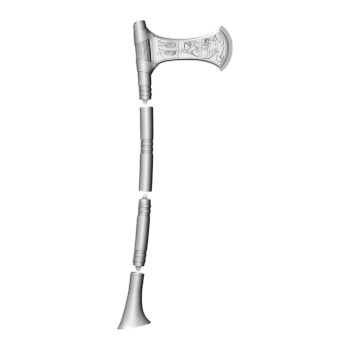
Assembled ancient Egyptian long handle axe (support 3D printing)

Middle Bronze Age flanged flat axe
"Flanged flat axe in the middle of the Bronze Age" is a metal tool/weapon popular in many parts of Eurasia in the middle of the Bronze Age (about 2000-1600 BC, depending on the region). Its core feature is that the axe head has a flange (Flange) (strip structure with the edge of the blade protruding outward) and a flat blade body (Palstave) (the blade is wide and thin, shovel-shaped or trapezoidal). It is a typical representative of the transition from stone tools to metal tools after the maturity of bronze smelting technology. It is not only a practical tool, but also a material witness of the complexity of early society.

Late Bronze Age with rings and axes
The late Bronze Age was a critical stage in the transition from stone tools to metal tools. With the maturity of bronze (copper-tin alloy) smelting technology, humans broke through the limitations of early stone tools and began to mass produce more durable and efficient metal tools. The emergence of the axe (Socketed Axehead) was an important technological breakthrough in this period-compared with the earlier "Flat Axe" (Flat Axe, which is easy to loosen by binding and fixing the wooden handle), its mortise hole design (inserting the wooden handle into the conical or cylindrical hole of the axe head, and fixing it by the close fit of metal and wood) greatly improved the stability of the tool.
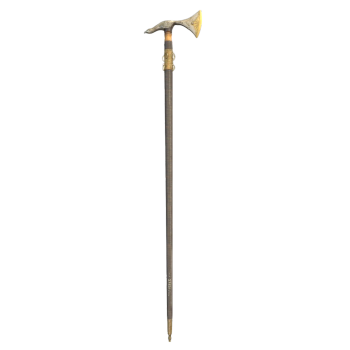
Nineteenth Century Crafts Shepherd's Cane Axe
This cane-axe was made in 1868 in Zakopane (Zakopane), Poland, by Józef Krzeptowski. Its design was inspired by the Highland Shepherd's axe for support while hiking. The cane is made of long, narrow maple wood with a French-polished finish. They are called "ciupagas" (shepherd's axe) in the Podehalle area, and young shepherds often throw them at targets or in the air and catch them while dancing to demonstrate their agility.

Bronze decorative axe
Bronze decorative axe discovered in Tomb 697 at the Hallstatt Cemetery in Austria.
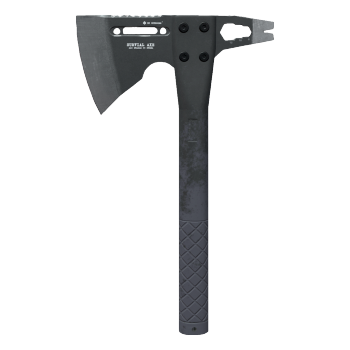
Firefighting hand axe

Carved bronze axe blade
This cultural relic is an axe blade, with a curved blade section and a quadruped animal engraved on each side of the blade surface. The artifact dates back to the early Iron Age in 1000 BC and was discovered in Koban Cemetery, North Ossetia. It is made of copper alloy and measures 17.5 centimeters in height and 5.5 centimeters in width. It is currently housed in the National Museum of Archaeology in France.

Weapon in the movie Avengers: Infinity War: Storm Axe
The Storm Axe, originating from the Marvel Cinematic Universe, made its debut in Avengers: Infinity War. It is a artifact created by the dwarf king Atreus on the planet Nidavi for Thor, capable of killing Thanos. The Storm Axe is a new weapon of Thor in the Marvel Cinematic Universe. Before the Twilight of the Gods, the hammer of Thor, Mjolnir, was crushed by the goddess of death, Hela. Since then, Thor has been without weapons and has had to rely on his own Thor power to fight. This new weapon, the Stormwind Axe, can be said to have given Thor new life.

Props in the game "Dying Light": Hand Axe

Prop for the game Assassin's Creed: Valhalla: Viking Throwing Axe

Prop for the game Assassin's Creed: Valhalla: Short handled Axe

Prop for the game Assassin's Creed: Valhalla: Viking long handled axe
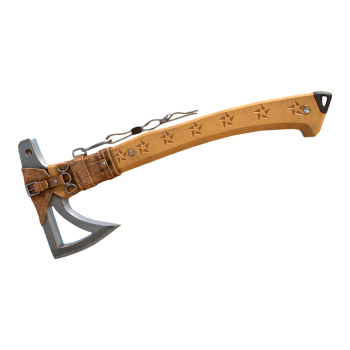
The axe in the action game "The Gone Light"
Dying Light is an action game developed by Techland and released on January 27, 2015. "Dying Light: Platinum Edition" landed on Nintendo Nintendo Switch platform in October 21. The game is set in a huge open world with ominous day-night cycles. During the day in the game, players will traverse a vast urban environment ravaged by a virus outbreak, searching the world for supplies and homemade weapons to resist the growing number of infected people.

wooden handle axe

stylized game tomahawk 3d model

Popular Models

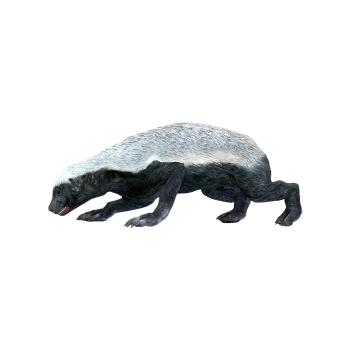
Honey Badger (3D animated model)
194 View
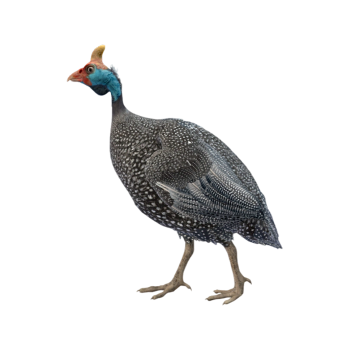
Guinea fowl (3D animated model)
165 View

Wild Goose (3D animated model)
187 View

Red Fox (3D animated model)
155 View
Random Model

scale-porous bacteria
650 View

Fighter Bf-109 during World War II
1356 View

Cell phones in the 1980 s.
940 View


Black Ladies Leather Tote
761 View


german Z-56 destroyer
701 View


Dyer Abbey
451 View
